Contributions originales Traductions Numéros spéciaux Recensions Interviews Essais photographiques

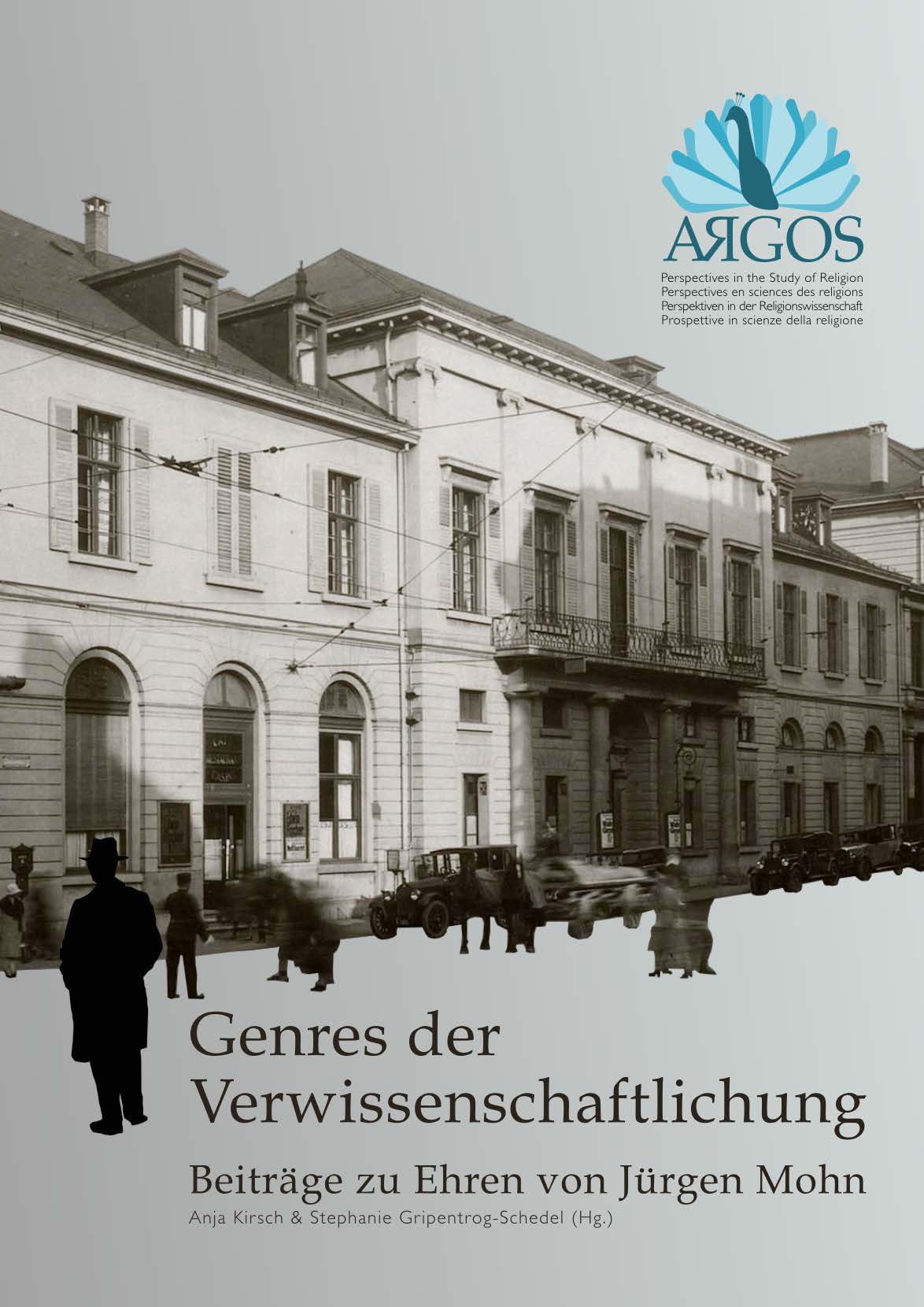
This introduction outlines the AЯGOS special issue Genres of Scientification, which explores the entanglements of religion and science across diverse social, political, and institutional contexts. Using the Second International Congress for the History of Religions of 1904 in Basel as a case study, it illustrates how claims to scholarly authority were asserted, negotiated, and contested, and how these dynamics took shape within specific textual, medial, and social forms. These forms are conceptualized as „genres of scientification”: social framing practices through which scientificity is performatively produced and modeled. Scientification is understood not as a linear progression but as a situated and often contentious process that interweaves epistemological, institutional, and socio-political perspectives. The issue thus investigates the cultural conditions and expressive forms of these processes and their significance for the emergence and self-positioning of the study of religion as an academic discipline.
In the 1830s and 1840s, protest movements across Europe emerged, whose political demands were closely linked to the pursuit of a just future society. From a history of religion perspective, this discourse on social justice and equitable society becomes tangible in the foundational discussions of the early socialist movement(s) arising in therevolutionary climate of the time. Their programmatic documents address both the foundation of future society and the essence of the new movement. The debates were held in the catechetical format. This article examines the communication circuits of over 40 catechisms from France, the UK, the States of the German Confederation, and the Swiss Confederation within their socio- and cultural-historical contexts. Using police interrogation protocols, congress transcripts and circulars, correspondences, personal letters, and memoirs of participants, it traces how the question of religion moved to center stage in early socialist identity debates. In the course of this debate, the relationship between Christianity and communism began to take shape as a relationship between religion and politics, without sharp boundaries being established. The analysis highlights how everyday distinctions, perceived ambiguities in the catechetical format, and a rising skepticism toward the genre prefigure the modern differentiation of religion and politics. Building on religious studies research on secularity, this article develops an approach to pre-conceptual distinctions, investigating the epistemological prerequisites for explicit conceptual boundary-drawing practices.
The negotiation of scientific rigor is by no means limited to intra-academic debates and theoretical literature. What is considered “scientific,” “factual,” or “impartial” comes to a head in the context of political, cultural, and religious questions about current events. The article traces the outlines and background of a debate that took place at the Colonial Congresses in Berlin in 1905 and 1910. This debate was primarily devoted to the question of how to assess Islam as a cultural factor. Important keywords in the debate were “Islam danger” and “Islam propaganda”.
Whether Islam was a religion in the modern sense was by no means a foregone conclusion. The demand for the separation of state and politics and for freedom of religion as a condition for the civilizing mission did not go unchallenged. Conversely, Islam was seen as an alternative to European civilization, which was considered decadent. The relationship between political, religious, and scientific interests in the debate was also controversial. Again, “unscientific” and “partisanship” were also used here as political battle concepts to discredit opposing arguments.
The article explores the specific role of psychological case studies for the scientification of religion, focusing particularly on the history of academic conferences. Beginning with foundational reflections on the epistemological importance of case studies and scientific conferences as sites of specific knowledge production, the analysis offers an illustrative glimpse into the evolving disciplinary discourse of psychology of religion. Specifically, the first international congresses on the psychology of religion held in 1930 and 1931 are examined. The analysis focuses mainly on the relevant conference proceedings and the significance of case studies for establishing the psychology of religion as an empirical science. Notably, the case study of Therese Neumann von Konnersreuth attracted attention, as it sparked considerable controversy not only within scientific circles but also in political discourse. The second congress in 1931 focused on the issue of unbelief, serving as a response to the perceived religious crisis of the time and once again relying on empirical research for its discussions. Both congresses stand for a shift in the disciplinary perspective: moving away from earlier “psychologistic” approaches in favor of a more apologetic stance.
The article contributes to the study of processes of the scientization of religion in and with regard to the Philippines around 1900, particularly within the Spanish-language colonial public sphere. It is built around an exemplary presentation of Spanish sources authored by Filipino intellectuals around 1900 that have so far received little attention in the study of religion. These texts in various media forms and genres, document manifold ways of negotiating the relationships between religion and science. In a preliminary account, this body of sources is made accessible for the ongoing discussion on a Global History of Religion. I present texts by Pedro Paterno and Isabelo de los Reyes, as well as contemporary journals and their mass-media environments. Finally, with reference to debates in media studies, the article raises the question of how genre theory and media theory might be related to one another as aspects of a Global History of Religion.
This contribution in honor of Jürgen Mohn heuristically contrasts science and religion. It argues that the two elements of this juxtaposition can be formally distinguished based on their respective relationships to cultural dynamics. To develop this idea, the essay draws on Juri Lotman’s concept of the semiosphere. Adopting Lotman’s spatial metaphors, science is associated with the periphery and religion with the center. Accordingly, science is portrayed as a cultural mechanism that sees itself as inherently open to transformation through information arriving from the periphery. In contrast, religion is understood as a cultural mechanism that seeks centralization, homogenization, and stability by attempting to immunize itself against such external influences.